Showing posts with label meat. Show all posts

Monday, April 12, 2010

Mixed Paella


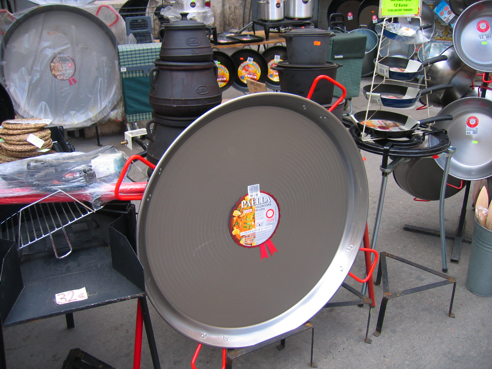
Paella, which has its origins in Valencia, is a very grateful dish. I really enjoy preparing it, serving it and eating it. You can make it with whatever you like (rabbit, chicken, shellfish, sausage, frogs or snails). Served in a big paella pan it looks and smells fabulous and it's a great dish to dig in with the whole family. There are many different types of paella, but this one has everything I like in it.

Serves 6
- good splash of olive oil
- 1 onion, finely chopped
- 3 cloves garlic, finely chopped
- 600 g semi-long grain rice or short grain rice (like risotto rice)
- about 0,8 l stock
- 6 chicken drumsticks
- 1 red pepper, chopped
- 1-2 g saffron
- 1 small and thin dry sausage like a dry salami, cut in thick coin sized slices
- 2 tomatoes, deseeded and chopped- 2 handfuls of peas (frozen will do)
- (15 mussels)
- 12-15 big prawns
- handful of parsley, finely chopped
- pepper, salt
- 1 lemon, cut in wedges


If possible use a big paella pan. This is a wide, shallow, thin base pan. If you don't have a paella pan, just use a big frying pan or a wok.
Start with sauteing onions and garlic on medium heat in some olive oil. When translucent add chopped red pepper and rice and stir until it's coated with oil.
Add some ladlesful of stock and stir. Let it come to a gentle boil and when all the fluid has been absorbed, add some more stock.
Roast your saffron in a dry hot pan. Then crumble it in the rice an stir.
In the meantime fry the seasoned chicken in a separate pan and keep warm (in some aluminum foil or on low heat in the oven) when crispy.
When the rice is close to being "al dente" add the sausage.
Fry the seasoned prawns in some olive oil.
Cook the mussels in their shells.
A few minutes before serving, add peas and tomato.
Taste and, if necessary, season with salt and pepper.
A few minutes later stir in tomato and peas.
Finish off with the chopped parsley.
Arrange drum sticks, prawns, mussels and lemon on top of the rice and serve. 

Thursday, April 1, 2010

White Asparagus with ham, egg and new potatoes


This dish is one of my all time favorites. Although it is not so much a recipe, more a combination of cooked items, it is definitely a great combination! In the Netherlands the season for Dutch white asparagus is starting soon (the season is roughly from half of April until half of June). I found them here in South Africa once or twice in November, but I have no idea where they came from. Anyway, they looked delicious and of course I had to prepare them our traditional way.

Serves 4:
- 1,5 kg white asparagus (thickest you can find!)
- 1 tsp sugar
- 6 eggs
- 400 g ham
- 1,5 kg new/baby potatoes, skin on
- a stick of butter, don't be shy
- salt 
- (grated nutmeg)

Ok, this is very easy. Peel the asparagus (with a special peeler), holding them flat on a cutting board (be careful not to break them) and cut about 1 cm off the end. Boil the strips of peel and the ends for 15 minutes in a pan with a liter of water with a bit of sugar and salt. Keep the asparagus in a bowl of cold water until needed.
Discard peel and ends, keep the liquid to boil the asparagus in.
Boil asparagus for 5 minutes in the asparagus liquid, remove from fire and leave them with the lid on the pan for about 15 to 20 minutes.
In the mean time, boil the potatoes in their skin for about 20 minutes, boil the eggs for 8 minutes, melt the butter on low heat in a pan and arrange cold ham slices in rolls on a plate.
Peel the eggs and arrange them on the plate with the ham.
Drain the asparagus and lay them on a plate with a cotton kitchen towel.
Serve with the potatoes, butter, salt and freshly grated nutmeg.

Saturday, March 27, 2010

Bitterballen / Kroketten, a very Dutch snack

This super Dutch bar snack is a delight for all. Surely not a healthy option, but sooooo good! You will find the bitterballen in most bars in the Netherlands and they make a great snack with a beer around five o'clock. The kroket is mostly eaten as lunch, on a soft bread roll. You will find them in fast food restaurants as well or in the also very Dutch "muur" (wall): some fast food restaurants have a heated wall with little windows you can open after putting some money in it. For both goes: don't forget the mustard!
So go ahead and wow your friends with this fantastic snack next time you throw a dinner party (and hire someone to deep-fry them for you a-la-minute...).

Makes about 20 kroketten or 60 bitterballen.

Filling:
- 50 g butter
- 50 g flour
- 1 cup of milk
- 1 small onion, finely chopped
- 1 clove of garlic, finely chopped
- 250 g (left over) cooked meat (chicken/veal/fillet of beef), finely chopped/shredded
- 1 handful of parsley, finely chopped
- 1 tsp nutmeg
- pepper and salt
- oil for deep frying
- mustard

for the coating:
- 1 cup flour, on a plate
- 2 eggs, lightly beaten with a splash of milk, on a plate
- 2 cups bread crumbs, on a plate


Melt butter in a saucepan.
Add onion and garlic and saute for 2 minutes, without browning.
Add flour and stir well for 2 minutes.
Add milk and keep on stirring until you end up with a smooth thick doughy sauce.
Add the meat and parsley and season with nutmeg, pepper and salt.
Let it cool down and put the mixture covered in the fridge for a couple of hours.
Form the mixture into 12 cm not too thick logs (kroketten) or into small ping pong sized balls (bitterballen).
(if they have "melted" a bit, put them in the freezer for about an hour, until they are firm again).

Roll each kroket or bitterbal through some flour first, then through the eggs and then trough the breadcrumbs. (Tip: to avoid extreme mess, do it in batches: start with rolling about ten of them in flour, then move over to the eggs and finish with the breadcrumbs).
Put them on a plate and cool them in the fridge or a couple of hours or in the freezer for an hour (or freeze them until you need them).

Heat frying oil in a heavy based pan to 180 °C and deep-fry the bitterballen in batches of eight or ten for about 4 minutes, kroketten in batches of six for about 6 minutes. Test the first one and be sure the centre is hot! (If you deep-fry frozen kroketten or bitterballen it will take a few minutes longer).

Serve the bitterballen with mustard (I prefer Dijon) and the kroketten on a white roll with mustard.
For a pescatarian version: take chopped prawns instead of meat, lemon zest and lemon juice in stead of nutmeg and add some dill! You could even make vegetarian ones with mushrooms.

Thursday, January 7, 2010

Slow roast Leg of Lamb with Rosemary, Sweet Cloves of Garlic, Anchovies and Lemon with a Vegetable Jus


- 1 leg of lamb, bone-in (about 2 kilo's, serves 6)
- 1 tin anchovies
- 1 salted lemon, chopped
- 1 handful of rosemary
- about 5 garlic cloves, peeled and halved
- 2 tbsp olive oil
- splash of water or wine
- pepper and salt
- 5 shallots or 2 onions
- 2 carrots
- 2 small potatoes, cut in four
- 2 celery sticks
- thyme
- handful of cherry tomatoes
- 1 tbsp honey

Before starting the preparation of your leg of lamb, let the meat come to room temperature first (this can take a couple of hours).
Make small but deep cuts with a knife and fill half of the pockets with some rosemary and garlic and the other half with anchovies and lemon. Just use your finger to push it inside and close the flesh afterwards. Rub your lamb with some olive oil and then with salt and pepper.
You need a casserole that is big enough for the whole leg. Add some olive oil to the casserole and, on the stove, brown the lamb all over. Take the leg out and saute the carrots, onions, celery and potatoes for a few minutes. Add thyme and a splash of white wine or water and put the lamb on top. Put the casserole with the lid on in a preheated oven (160 °C) and leave it there for four hours.
Half an hour before the dish is ready add some cherry tomatoes and honey and return to the oven for 30 minutes. Take casserole out of the oven en let the meat rest for about 15 minutes.
While the meat is resting, put the liquid (if there's a fatty layer on top, spoon it off first -I use my new very useful kitchen tool: the fat separator-) and the vegetables in a blender, puree and strain. The result is aromatic succulent piece of lamb and a light but creamy jus.